
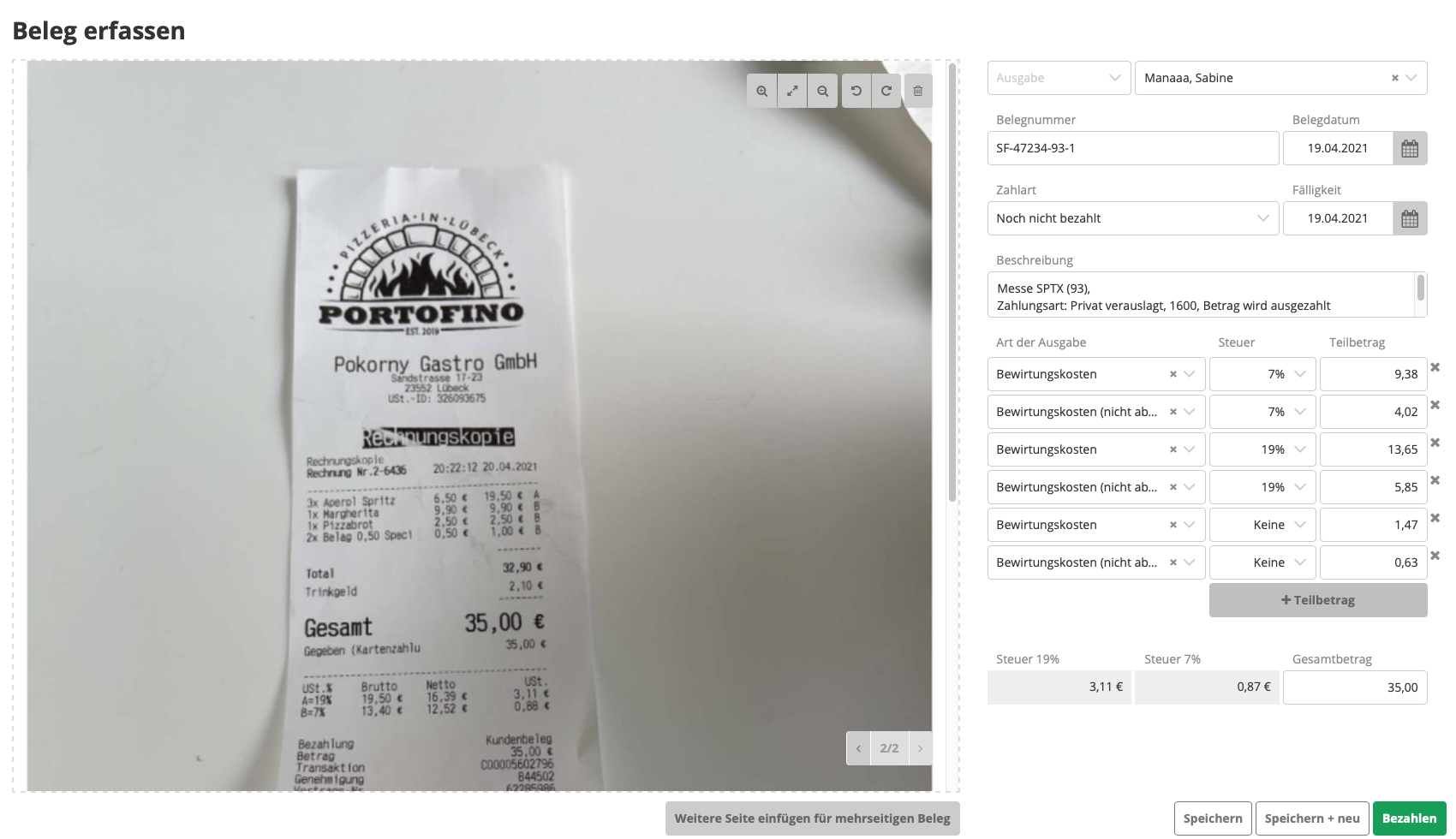
What belongs on an entertainment receipt, how to enter the tip, and how food, drinks and tips are booked to the SKR03 and SKR04 accounts under the 70/30 rule. A business meal with a customer is quickly paid for. For the costs to be recognised for tax purposes, however, accounting needs a complete entertainment receipt and a split into food, drinks and tip. This article shows what belongs on the receipt, how to enter the tip correctly and which accounts are used in SKR03 and SKR04, with a fully worked example. The rules described apply to companies in Germany. For entertainment expenses to be recognised, it is important to get a correct receipt while still in the restaurant. The German Federal Ministry of Finance (BMF) set out the requirements in its letter of 30 June 2021. A complete receipt consists of two parts: The restaurant’s invoice (machine-generated, from a till with a technical security system) with The details of the entertainment, which you add and sign yourself: Many restaurants print a form for this on the invoice. If you capture your receipts digitally, you can also add the details electronically, provided they are firmly linked to the invoice. The tip is usually not on the invoice. Enter it under the amount of the expenses and ideally have the service staff confirm it on the invoice. When paying by card, the card slip also shows the total including tip. Booking the tip: the tip contains no VAT, so it is booked without a tax code. For business entertainment it is split like food and drinks: 70% to 4650 (SKR03) or 6640 (SKR04), 30% to 4654 or 6644. For company-internal entertainment it goes to 4140 or 6130. Business entertainment exists when external persons took part, such as customers, prospects or contractors. In that case only 70% of the reasonable costs are deductible as a business expense. The remaining 30% are not deductible and are therefore booked to a separate account. Each of the three amounts (meal, drinks, tip) is split into a 70% and a 30% part. That results in 3 times 2 bookings. For business entertainment with at least one external person, up to 6 booking records are created: An employee invites a customer to dinner. The invoice shows food for €60.00 (7%) and drinks for €23.80 (19%), plus a €6.00 tip. In total she paid €89.80. Net amounts and input tax together make up the €89.80 paid. €57.45 (the 70% shares) count as a business expense, €24.62 are not deductible. The input tax of €7.73 is fully deductible. If she paid privately, the employee is reimbursed the €89.80 with her expense report. Company-internal entertainment exists when only your own employees took part. The 70/30 rule then does not apply and the costs are booked as follows. For company-internal entertainment, up to 3 booking records are created: Whether entertaining employees leads to taxable wages for them, for example at a working meal or a company event, depends on the occasion and the amount. It is best to clarify this with your tax advisor. Entertainment on a trip: If you take part in an entertainment paid for by your company while on a trip, the meal counts as provided and the per diem for that day is reduced. In Spesenfuchs, mark the meal on the Days page of the trip. If a customer or business partner entertains you instead, there is no reduction. Splitting the meal and the drinks is necessary because of the different VAT rates. Since 1 January 2026, food in restaurants has been taxed at a permanent 7%, drinks still at 19%. In 2024 and 2025, food was also taxed at 19%. What the reduction from 2026 means for travel expenses is explained in the article VAT reduction in the hospitality industry from 2026. Background on the earlier, temporary reduction can be found in the article Information on the VAT reduction. The date of the meal is decisive, not the invoice date. With travel expense software you do not have to put the bookings together yourself. In Spesenfuchs it works like this: This is how capturing an entertainment receipt looks in Spesenfuchs:Post entertainment receipts correctly
Booking an entertainment receipt: the essentials
Booking
SKR03
SKR04
Entertainment costs 70% deductible (food, drinks, tip)
4650
6640
Entertainment costs 30% not deductible
4654
6644
Company-internal entertainment of employees only
4140
6130
What must be on an entertainment receipt?
The tip on the entertainment receipt
Business entertainment: 70% deductible, 30% not
Description
VAT
SKR03
SKR04
Meal 70% deductible
Reduced
4650
6640
Meal 30% not deductible
Reduced
4654
6644
Drinks 70% deductible
Standard
4650
6640
Drinks 30% not deductible
Standard
4654
6644
Tip 70% deductible
none
4650
6640
Tip 30% not deductible
none
4654
6644
Worked example: business meal with a customer
Booking
SKR03
SKR04
Net
Input tax
Food 70%
4650
6640
€39.25
€2.75
Food 30%
4654
6644
€16.82
€1.18
Drinks 70%
4650
6640
€14.00
€2.66
Drinks 30%
4654
6644
€6.00
€1.14
Tip 70%
4650
6640
€4.20
€0.00
Tip 30%
4654
6644
€1.80
€0.00
Total
€82.07
€7.73
Company-internal entertainment: employees only
Description
VAT
SKR03
SKR04
Meal
Reduced
4140
6130
Drinks
Standard
4140
6130
Tip
none
4140
6130
Why separate food and drinks?
Booking entertainment receipts with Spesenfuchs
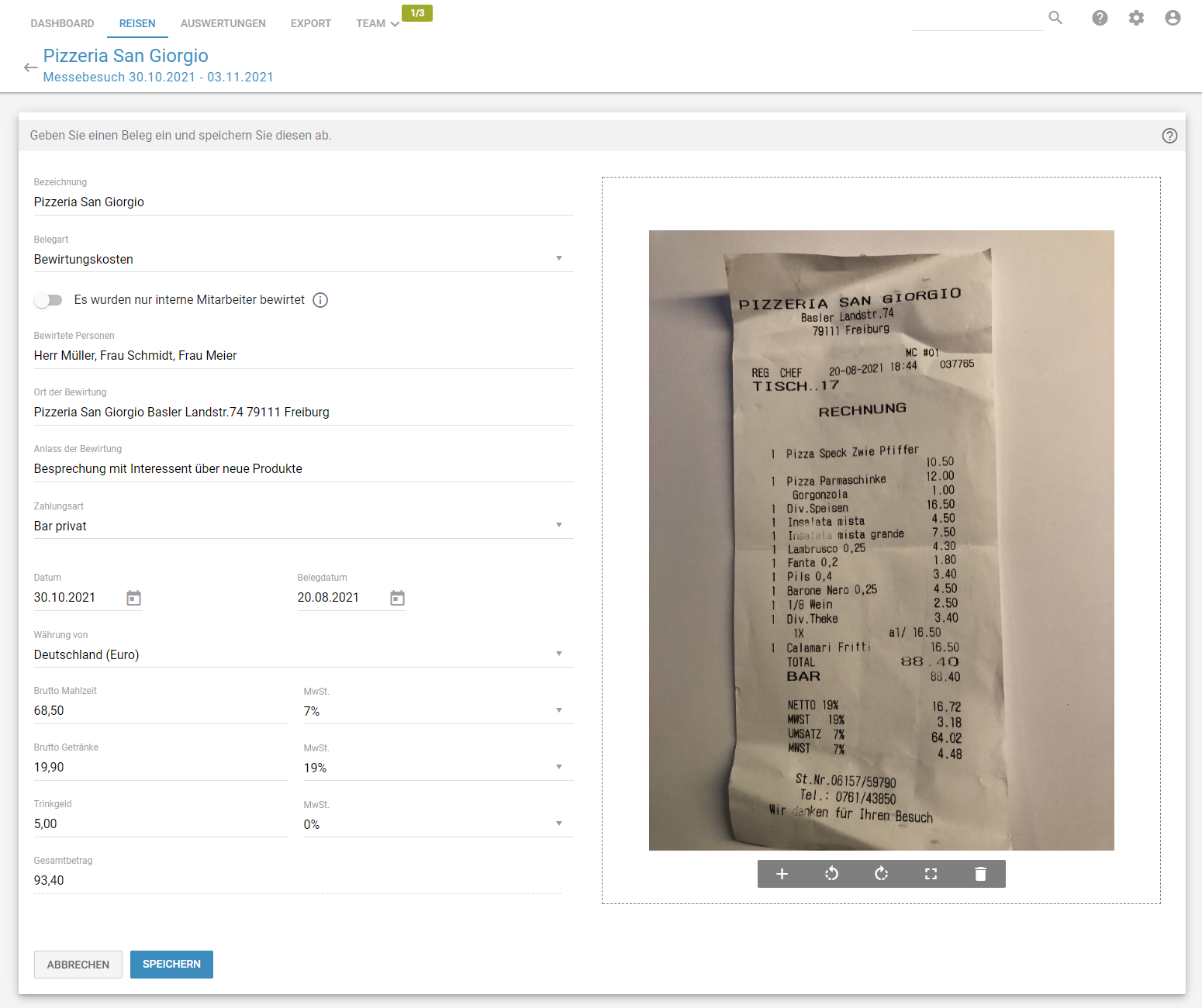
In the accounting software, the automatically generated bookings then arrive like this, shown here for sevdesk and Lexware Office (screenshot still under the former name lexoffice):

Please note that for high amounts or for company-internal entertainment involving the business owner, further rules may apply that Spesenfuchs does not cover. Apart from that, the automatic split is one of the features that sets Spesenfuchs apart from most other software solutions.
More guides: Create travel expense report, DATEV export of travel expenses. All receipt types in Spesenfuchs are on the page Receipt types.
Related features for entertainment receipts
All features at a glanceCompare PRO and TEAM in detailIntegrations